
Member Club of

HOME PAGE: click here for more information about our club

Member Club of


        Click here to go to the Home Page

HOME PAGE: click here for more information about petanque and our membership program.


Where and When to Play Petanque


Weather permitting, our petanque players usually meet at

                2:00PM (April through September) or 1:00PM (October through March)

In addition, when summer evenings are long, play will often commence at

Another option nearby: The Edmonds Petanque Club
 

Click on the boule to ask for more information by e-mail
 

About the Game of Petanque


Click here for basic petanque rules.

The Ancient Greeks played a game of tossing coins, then flat stones, and later stone balls, called spheristics, trying to have them go as far as possible, as early as the 6th century B.C. The Ancient Romans modified the game by adding a target that had to be approached as closely as possible. This Roman variation was brought to Provence by Roman soldiers and sailors. A Roman sepulcher in Florence even shows people playing the game and stooping down to measure the points.

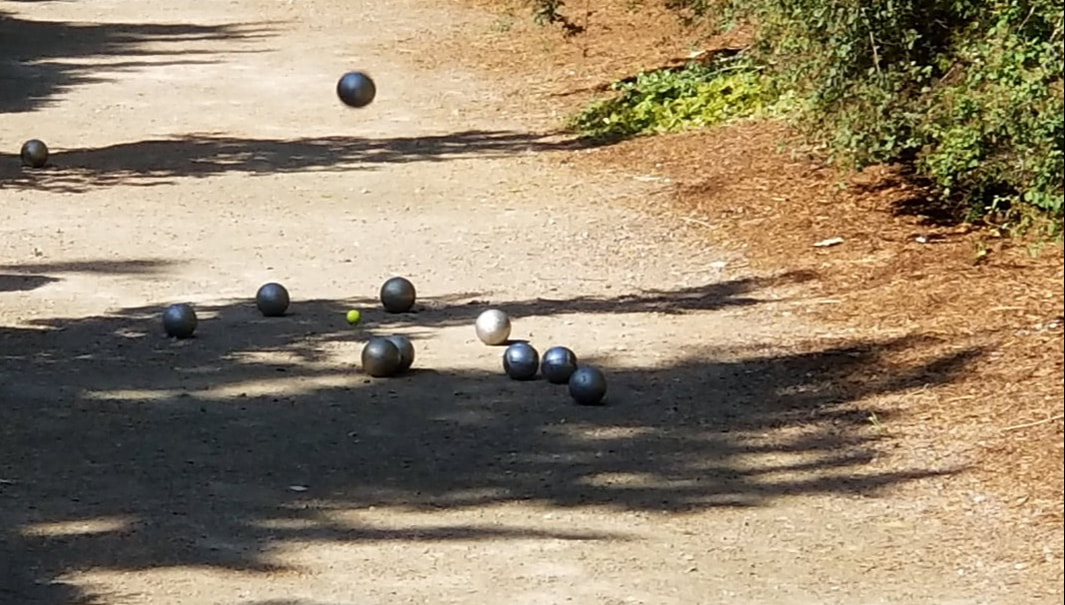
Pétanque (French pronunciation is [petonk]) is a game of boules where the goal is, while standing inside a starting circle with both feet on the ground, to throw hollow metal balls as close as possible to a small wooden ball called a cochonnet (literally "piglet") or jack.  The game is normally played on hard dirt or gravel, but can also be played on grass, sand or other surfaces. Similar games are bocce (Italy), bowls (Commonwealth Nations). Closely related games in France include "Jeu Provençal" and "Boules Lyonnaises" similar to pétanque but played on longer courts, and "Boules Bretonnes" which is similar to bocce.

The current form of the pétanque game originated in 1907 in La Ciotat in southern France. The name pétanque comes from pès tancats meaning "feet together" or "feet anchored" in the Provençal dialect of the Occitan language.

A casual form of the game of pétanque is played by about 17 million people in France, mostly during their summer vacations. Players participating in tournaments are usually licensed with the Fédération Française de Pétanque et Jeu Provençal (FFPJP).  There are some 375,000 licensees in France and some 3,000 in England. Another 20,000 or so play in Quebec. 
Pétanque is also played in Asia, in countries like Laos, Thailand, Vietnam, and Cambodia.  Additionally, pétanque clubs like the Seattle Petanque Club have appeared in cities throughout the United States in recent years.


About the Seattle Petanque Club


The Seattle Petanque Club is a non-profit sports organization, informal since 1995 and formally affiliated since 2005 with the sport's national and international organizations, the Federation of Petanque USA and the Fédération Internationale de Pétanque et Jeu Provençal.  This affiliation gives club members a license to play at other clubs and compete nationally and internationally.  Anyone of any age may apply for membership in the Seattle Petanque Club for a modest annual fee (currently $30.00, or $20 if you are under 18).

We encourage you to become a club member, but you do not have to be a member to play.  Come and join us any time for a game or two. You'll meet a bunch of friendly, happy people ready to welcome you and show you the basics of the game. At first, do not worry about bringing your own boules, because there are usually extra boules to share at the parks.


Game at Cal Anderson Park


Click here to go to the Hoime Page HOME PAGE: click here for more information about petanque.  We are looking forward to your visit!

HOME PAGE: click here for more information about our club
Petanque Players at Cal Anderson Park
Click on the boule to contact us by e-mail